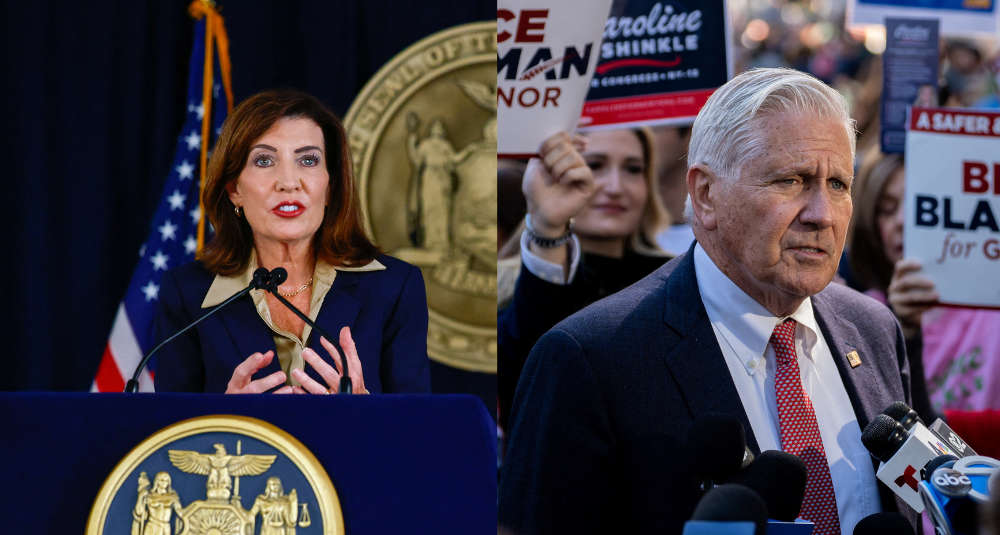
New Yorkers do not need another Albany false promise announcing millions or billions of dollars in new spending. They need to know why everyday expenses remain such a burden, whether public-safety policies are delivering results and whether the state’s government understands the financial pressure facing working families. Governor Kathy Hochul has spent years promoting creating a double standard while in office by not addressing the problem. Instead gifting New York City’s Mayor Mamdani a blank check to further deplete taxpayers of their hard-earned savings.
Republican challenger Bruce Blakeman is campaigning on a different set of priorities. He has promised reducing the tax burden, restoring law-and-order and reversing energy policies that he says are driving up costs. His proposals put the focus on recurring household expanses and the consequences of reckless state policy.
New York’s one and only gubernatorial debate tonight, Tuesday, October 13th, 2026, gives both candidates the opportunity to defend their record and explain their plans for New Yorkers, their wallets, neighborhoods and futures.
1. Affordability & The Cost of Living
In every facet of life, New York’s affordability problem is felt throughout the entire state. According to a Tax Foundation report, the state of New York is ranked number one nationally in total state and local tax burden per resident, with an estimated 12.5% of taxpayer’s income going into the pockets of single-rule Democrats in the capital. This is a clear message that Albany can no longer ignore. Taxpayers want more than a pledge that the government is spending money on their behalf. New Yorkers demand to know why so much of their income goes towards taxes while housing, groceries and other necessities remain unaddressed.
Hochul’s record while in office is a key reason why New Yorkers can’t find fiscal relief anywhere in the state. New York’s 2026 budget had expanded rapidly, reaching a historic $268 billion mark. This enormous spending trajectory prevents lowering the baseline tax rates. Not to mention, Hochul’s approval of a new pied-à-terre tax that would place a surcharge on luxury second homes in New York City, aligning with Mayor Mamdani. These initiatives do not automatically lower the recurring costs families face after the checks have been spent. A rebate can help cover a bill but won’t stop the bleeding that is the suffocating tax structure. After years of Hochul’s budgets and relief packages, there’s no lasting improvements that families can feel assistance.
Blakeman has proposed the largest income tax cut in the state’s history, exempting the first $50,000 of income for single filers and $100,000 for joint filers, with his campaign estimating that a married couple could save $4,000 per year. When elected he would implement a 10% property-tax reduction and direct 70% of new state revenues towards tax relief. The appeal is clear. Rather than relying on government spending, his plans aim to leave more money with taxpayers in the first place. As Nassau County Executive, he blocked a $150 million property tax increase and kept local sales and property tax rates frozen while in office. Blakeman looks to expand these proposals to all New Yorkers.
The central debate is whether Albany can continue expanding its spending commitments while families are demanding lower costs and whether Blakeman can translate his tax-cut proposal into a detailed, workable budget.
2. Immigration & ICE
Immigration enforcement has become another major diving line. In 2026, Hochul signed the Local Cops, Local Crimes Act, restricting cooperation with federal immigration authorities. State policy should not interfere with federal immigration operations, especially when an individual in local custody is suspected or convicted of a serious offense. Limiting partnerships between state and local law enforcement and federal agents have made communities less safe. New Yorkers deserve a clear explanation of how the law protects public safety while preventing unnecessary interference with federal enforcement.
Hochul contends that New York does not provide sanctuary for criminals and maintains that local police can cooperate with federal authorities on criminal matters without working with ICE agents. With her enactment of Local Cops, Local Crimes Act, the law prohibits ICE agents from fulfilling their duties while the state makes it harder to restore safety in their communities. New York county sheriffs argue that stripping police the ability to collaborate with ICE returns the violent criminals back into society. Department of Homeland Security Secretary Markwayne Mullin criticized Kathy Hochul and other New York leadership after data indicated the state had rejected to detain 16,000 dangerous criminals. It’s evident by the state’s policies that Kathy Hochul rather make communities less safe.
Blakeman vowed on his first day in office, he will sign an executive order ending New York’s status as a sanctuary state. This declaration would strip away any legal shields that prevent the state’s law enforcement to comply with federal immigration agents. His position is that immigration enforcement and local policing can work together, in cases involving more serious offenders. During the campaign, he cited Nassau County’s participation with federal authorities' operations and helped remove 2,000 undocumented individuals with criminal records from the county. Blakeman has contributed public safety to fiscal stability. By ending New York’s spending for migrant services, he can redirect billions of dollars back into essential services lacking in the shadows like local police departments, upgrading infrastructure and securing communities. With Blakeman’s running mate being Madison County Sheriff Todd Hodd, they can ensure that immigration enforcement can offer support rather than hinder the front-line officers protecting each county.
The debate should establish exactly how Blakeman can restore cooperation, what safeguards he would support and how his administration would distinguish serious criminal cases from civil immigration matters. The bigger issue is whether New York’s current policies make it easier or harder for law enforcement agencies to carry out public safety.
3. Crime & Policing
Hochul's administration has displayed funding for law enforcement, prosecutors and gun-violence prevention, including hundreds of millions of dollars in criminal-justice action. However, government spending is an input, not an outcome. Residents want to know whether crime is being addressed. Statewide averages can also obscure differences between New York City, Long Island and upstate areas. If the administration believes its approach is working, it should be prepared to establish that through crime trends, staffing figures, response times and case outcomes.
Hochal can object that crime prevention requires more than arrests and that effective policing must operate alongside prevention programs, prosecution and fair treatment under the law. Those considerations can only help so much, but they should not become reasons to avoid examining policies that may fail victims or leave officers without sufficient tools. The state’s bail laws allow violent and repeat offenders to be released back onto the streets nearly immediately after an arrest. Hochul failed to fully repeal the measure. The “Raise the Age” law, which ended the practice of charging 16- and 17-year olds as adults for several crimes, enabling youth gangs to operate with small consequences. Another point of contention is the HALT Act, which restricts the use of solitary confinement in state prisons. Blakeman guaranteed to reverse those restrictions, fighting for a tougher approach to prison discipline and safety.
Blakeman’s campaign reiterates his record as Nassau County executive and presents the county as an example of his law-and-order attitude. Nassau's index-crime rate fell 13% between 2022 and 2024, according to a PolitiFact review. He wants to expand neighborhood patrols and improve response times by putting expenses into massive hiring of state and local law enforcement. In that same PolitiFact review, Nassau County hired over 600 new police and law enforcement officers, which he credits for the drop in crime. Once in Albany, he plans to rehire 2,000 state correction officers who were terminated following the 2025 strikes, with the intent of alleviating the staffing crisis inside New York prisons. Alongside rehiring the wrongly fired correctional officers, Blakeman plans to repeal many of the pro-criminal legislation that has put communities at danger like cashless bail, HALT Act and Raise the Age initiatives.
The debate should focus on practical questions on retaining or hiring officers, prosecute serious offenses and addressing how to make neighborhoods safer.
4. Energy Prices & Climate Policies
Energy costs have become a central concern in this 2026 debate. New York utilities have experienced rate hikes thanks to fuel shocks and modernizing the state’s aging power grid. The Empire Center reported that New York’s average residential electricity price reached 29.90 centers per kilowatt-hour in July 2026, the fifth-highest in the country and 63.3% above the national average. The organization estimated that a householding using 800 kilowatt-hours per month would spend about $2,722m hundreds more in previous years. They underscore the pressure on households and business and the need for Albany to take accountability for these skyrocketing rates.
Hochul has defended the state’s clean-energy transition and pointed to rebates and expanded assistance programs as ways to help consumers manage costs. Her administration says that cleaner energy, grid modernization and investment can advance environmental goals while strengthening New York’s future economy. The challenge is whether those ambitions can be delivered without imposing excessive costs on households. The 2019 Climate Leadership and Community Protection Act (CLCPA) mandates that New Yorkers switch to 70% renewable electricity in less than four years in 2030 and a zero-emission grid in 2040. This forces a rapid shift away from reliable fossil fuels. A memo from the New York State Energy Research and Development Authority (NYSERDA) estimated that if left unchanged, the regulations could cost upstate natural gas and heating oil customers an extra $4,000 annually. Fiscal watchdogs find that Hochul is using utility companies as a scapegoat to deflect from the multi-billion-dollar price tag of her own climate mandates. The utility rate hikes Hochul opposes are largely designed to fund the state’s CLCPA policy. To meet the mandate of a zero-emission grid, companies like NYSEG must build massive green infrastructure, install vehicle charging grids, expand wind/solar hookups and upgrade aging grids to prevent blackouts. The costs of these state-mandated projects are naturally passed to consumers. The administration heavily championed major multi-billion-dollar green projects knowing the construction costs would be socialized through utility bill surcharges applied to all New York residents. The structural burden of these green policies became so pronounced that Hochul implicitly validated critics’ math by lobbying to roll back and delay key parts of her own climate law, explicitly citing severe affordability crises for middle-class consumers.
Blakeman has campaigned to lift the state’s fracking ban, reconsider clean-energy mandates and expand natural-gas and nuclear power. He has debated that increasing energy supply and revisiting restrictions could help reduce costs and make New York more attractive to businesses. He intends to expand localized energy production by lifting New York’s long-standing ban on natural gas fracking. He promises to open up drilling in the Marcellus Shale region across the Southern Tier and points to neighboring Pennsylvania as a direct model. Claiming their utility rates are drastically lower because they extract their own natural gas. By flooding the local market with New York’s own raw energy supply, he argues heating and electric prices will change. Blakeman has called for the immediate dissolution of the Climate Investment Account managed by NYSERDA. He promises to bypass the agency on day one and refund the $2.4 billion from the green energy slush fund back to the ratepayers to provide immediate utility bill relief. He dismisses Governor Hochul’s alternative $200 energy rebate checks as “peanuts” compared to what he has in mind. At the core of Blakeman’s regulatory strategy is the complete dismantling of New York’s signature climate laws. He has vowed to repeal the CLCPA and the All-Electric Buildings Act. His platform states to halt state-subsidized offshore wind projects and battery storage mandates. In his own findings, Blakeman says that over 70% of a modern New York electric bill is made up of hidden state-mandated fees, delivery surcharges and green transition subsidies. By removing these state policies, he claims utility corporations will no longer have to pass compliance costs down to consumers.
The debate should establish how quickly any changes could take effect, what infrastructure would be required and how proposals would affect household bills. Another fixture of this topic is the moratorium of data centers placed in the state. Governor Hochul has positioned herself as a protector of everyday ratepayers and local resources against unchecked big-tech expansion. While Blakeman has slammed her moratorium, he called the policy “anti-business” that drives technological investment out of the state and rather welcome the liquid gold into the state.
5. Candidates Records
The state of New York hangs in the balance of this gubernatorial race. No hyperbole or exaggeration. The state’s finances have plummeted in the time that Kathy Hochul and her predecessor have taken office. In 2025, New York State added a net total of just 1,008 new residents as post-pandemic recovery flattened. This made New York the sixth-slowest growing state in the nation. The state’s overall population is down by almost 120,000 residents compared to 2020. Due to this slowing growth, estimates indicate New York is highly likely to lose further seats in Congress and the Electoral College after the next decennial census in 2030. A CBS analysis found that between 2019 and 2023, New Yorkers who left New York City made $68 billion more than those who moved in. Out of that shifting wealth, $14 billion in taxable income moved directly to Florida. The city’s share of millionaires has actively shrunk. Households with young children are 40% more likely to leave the state, largely driven by housing costs. There is a fundamental problem in keeping New Yorkers in the state that many call home. How can the candidates’ record help residents want to stay in the state they love?
When Kathy Hochul took office in 2021, she promised to root out toxic political culture and establish a “new era of transparency” in Albany. This promise remains unfulfilled. In this time, Hochul’s administration failed to publish updated state transparency plans, with many state agencies offering fewer operational details than in previous tenures. Her economic plans have failed to curb the state’s affordability crisis. Her record on crime, pointing towards the state’s bail reform framework and the Local Cops, Local Crimes Act from August 2026. Good-government scrutinized Hochul for exploiting loopholes in state ethics mandates. Reports highlighted her campaign accepted hundreds of thousands of dollars from individuals serving on state boards and commissions. Governor Hochul’s relationship with NYC’s Mayor Zohran Mamdani is harmful that drags state policy to the progressive hard-left, forcing everyday New Yorkers to foot the bill for an aggressive tax-and-speed city budget, an anti-law enforcement stance and polarizing cultural policies.
Blakeman’s agenda offers a contrasting campaign centered on lowering taxes, energy-policy changes, expanded cooperation with ICE agents and a tougher approach to public safety. He is a proven tax-cutter and law-and-order leader who has provided a successful blueprint of governing. His tenure in Nassau County indicates his leadership is needed to reverse New York’s high cost of living and public safety challenges. Upon taking office as Nassau County executive, Blakeman fulfilled his promise to eliminate $150 million in scheduled property tax hikes and secured seven Wall Street credit rating upgrades. He highlights that Nassau County was named the safest county in America under his watch. There, he utilized an agreement to have local jail facilities coordinate directly with federal ICE authorities. His constituents praise Blakeman for his common sense executive actions, noting he signed the state’s first executive order restoring parents’ rights to reject school mask mandates and implemented regulations prohibiting biological males from participating in women’s sports on county property. Blakeman is the only way to dismantle New York’s crippling tax burden and replace Albany’s soft-on-crime policies with a proven track record of fiscal discipline and unconditional support for law enforcement.
This debate turns on what New Yorkers expect from their state government. Hochul is asking voters to judge her by the relief program and investments her administration has advanced. Blakeman is asking them to consider a shift toward lower taxes, a different energy strategy, strong immigration enforcement cooperation and a more assertive law-and-order approach. The question facing the governor is concrete: have her policies made life more affordable or less? For Blakeman, his proposals put those questions on center stage. The debate should give voters the necessary details to compare the administration’s record with a better alternative.
You can watch the New York gubernatorial debate between Democratic Governor Kathy Hochul and Republican challenger Bruce Blakeman tonight, Tuesday, October 13, 2026, at 7:00 p.m. ET through Spectrum News NY1.