

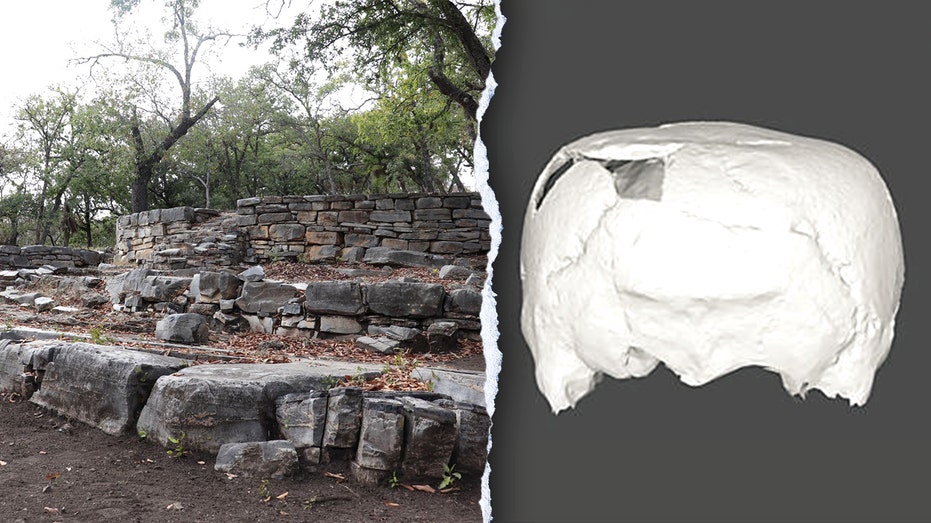
Archaeologists in Mexico discovered a rare 1,400-year-old cube-shaped skull, revealing ancient cranial modification practices used by Mesoamericans.
Archaeologists recently uncovered a surprising 1,400-year-old skull in an ancient village in Mexico — unusual for both its flat top and cube-like shape.
Mexico's National Institute of Anthropology and History (INAH) announced the find. Officials said the skull was found in the Balcón de Montezuma Archaeological Zone, in the Northern Huasteca region of Tamaulipas.
The skull belonged to a man who lived between 400 and 900 A.D. He was over 40 years old when he died, officials said.
FACES OF ANCIENT MUMMIES, HIDDEN FOR CENTURIES, FINALLY REVEALED THROUGH DIGITAL RECONSTRUCTIONS
The man had a peculiar tabular erect-type skull — with the front and back of the head purposely flattened.
The skull also has an unusually flat top, giving it a cube-like shape, similar to the rare tabular superior form.
"As a result, not only was intentional cranial deformation identified for the first time at this type of site, but also a variant of cranial modeling not previously reported in this region of Mesoamerica," the INAH press release said.
In a translated written statement to Fox News Digital, INAH researchers said they believe the skull may have had meaning related to identity and status.
"Not all individuals at the site (for whom we have complete skeletons) show this kind of cultural modification," the researchers said.
CLICK HERE TO SIGN UP FOR OUR LIFESTYLE NEWSLETTER
"In other words, this individual clearly stood out from others, which gave him a differentiated position."
The man's position was not "necessarily a high social status" — and the experts suggested he may have held a shaman-like role within the group.
Though cranial deformations were not unheard of in Mesoamerica, researchers stressed that this type is less common than other types in the region — and unusually combines both tabular erect and tabular superior styles.
CLICK HERE FOR MORE LIFESTYLE STORIES
"The differences among them lie in the lateral projection angle between the frontal, occipital and/or coronal bones," the team said.
The team also said the grave was unusual for its small circular shell beads, which served as personal adornments.
"This new discovery provides highly relevant data on the nature of intercultural relationships in the Huasteca region — especially with the North and the Sierra Madre Oriental of Mexico," the researchers added.
TEST YOURSELF WITH OUR LATEST LIFESTYLE QUIZ
"It not only shows the high degree of ethnic diversity, but also provides insights into the physical characteristics of its inhabitants."
The discovery is only one of many archaeological finds that were uncovered in 2025.
In El Salvador, excavators found "creepy" puppets at the top of a pyramid that dated back over 2,400 years.
This summer, a Texas couple unearthed the ancient tomb of a legendary king in Caracol, Belize, a major Mayan city established in the 300s A.D.
 Trump targets ISIS in Nigeria amid warnings Sahel region is becoming ‘epicenter of terrorism’
 Boxing star Anthony Joshua injured in fatal car crash in Nigeria
 Start 2026 strong with planners and calendars for every budget
 Missing 19-year-old Camila Mendoza Olmos believed to be 'in imminent danger,' Texas sheriff says
 Protein-packed comfort food rocked 2025, Google's top 10 viral recipes reveal